

The Pole Dance is a practice that has become increasingly popular for offering countless benefits for both the body and mind. But do you know the history of Pole Dance?
Its origins still raise many questions, as Pole Dance combines strength training and dance. In general, Pole Dance can be defined as a combination of acrobatic strength movements inspired by calisthenics and gymnastics, along with dance movements performed on a vertical metal pole, either static and/or spinning.
Although the strength-based acrobatics found in Pole Dance have roots in ancient practices from different cultures, it was through dance that the discipline eventually became widely popular. As we will see below, dancing around a pole followed a fascinating journey before becoming associated with the well-known strip clubs.
While acrobatics on vertical poles had been practiced much earlier in India and China, it was during the 1920s that the erotic Hoochie Coochie dancers began incorporating the poles near the stage, which supported the tents, into their performances. Over the years, the practice moved from tents to nightlife venues through Burlesque performances in the 1950s. These venues eventually evolved into the strip clubs we know today.
Below, we will take a closer look at the history of Pole Dance and understand how each element that makes up the discipline emerged. We will explore its past by examining the origins of Pole Dance, analyze its present, and take a glimpse into what the future may hold for the practice. We wish you a great journey through this fascinating history!
THE PAST – Some of the Influences Behind Pole Dance
Strength Acrobatics:
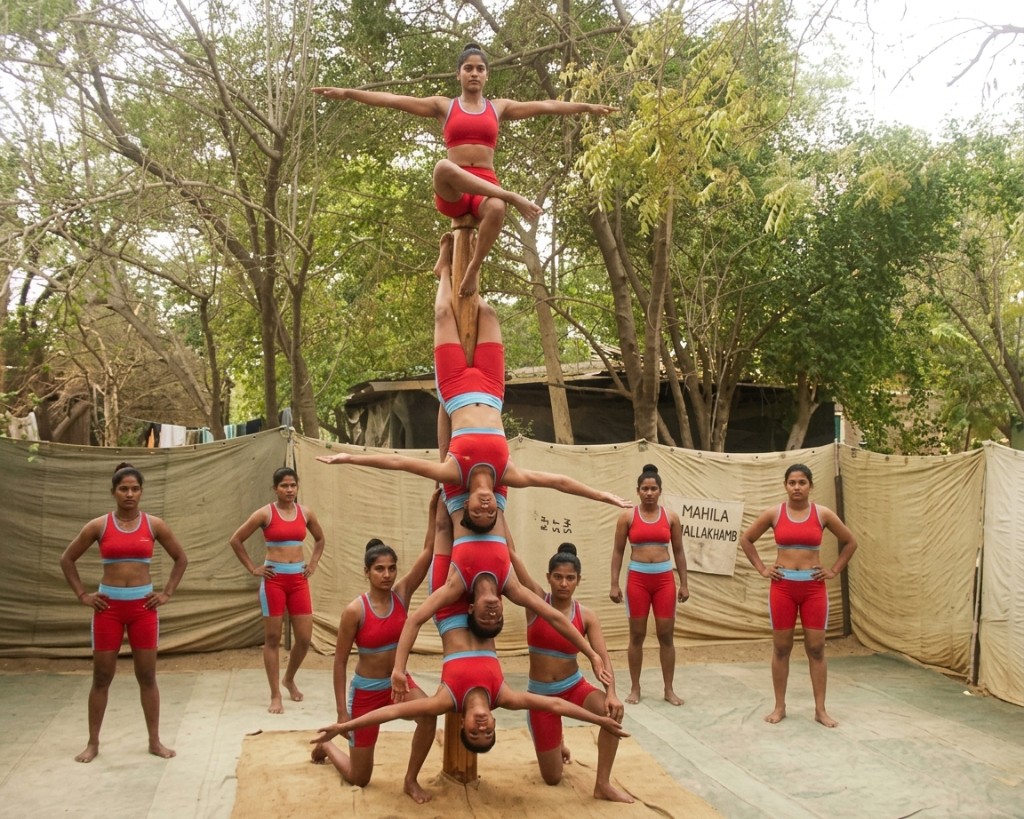
INDIA: MALLAKHAMB
The acrobatic movements found in Pole Dance can be traced back to the practice of Mallakhamb (malla = strong man or gymnast, and khamb = pole), which has existed in India since the 12th century. Often described as an Indian form of yoga, it is a traditional gymnastics activity and a nationally recognized sport.
Mallakhamb was historically used by wrestlers and military personnel as part of their training. The practice consists of performing movements involving balance, flexibility, and strength on a vertical wooden pole or ropes. It requires agility, concentration, physical endurance, and cardiovascular conditioning.
GREECE: CALISTHENICS
Calisthenics is a term derived from the Greek word kallistenés, meaning “full of vigor.” In the past, the term was associated with the balance between physical, mental, and spiritual qualities.
The Greeks sought harmony between the mind and body, with ideas centered around beauty, balance, and the aesthetics of the human form. Gymnastics, similar to modern calisthenics, was structured during the 19th century and aimed to develop strength while also emphasizing beauty through the shapes and curves of the body.
It was developed in France by the Swiss educator Phoktion Heinrich Clias, who began spreading the practice in England around 1822. It soon became popular around the world and was incorporated into Physical Education classes in schools.
Today, calisthenics has been incorporated into other disciplines such as Functional Training, CrossFit, Street Workout, and Pole Dance. It was designed for everyday people—not just athletes. Calisthenics is a form of physical exercise that uses nothing more than your own body weight.
CHINA: CHINESE POLE
Another discipline that can be considered an important reference is the Chinese Pole, which dates back to the 1800s. It became popular in the Western world through performances by the Imperial Chinese Circus.
The apparatus consists of an iron pole covered with a non-slip material and typically ranges from 3 to 7 meters in height. Rubber, EVA foam, neoprene, fabric, plastic coating, or even the bare metal surface can be used.
Because of its surface and grip, practicing on a Chinese Pole can cause burns, which is why long pants, T-shirts, and sometimes even long-sleeved shirts are recommended.
The discipline requires acrobatic preparation, muscular strength, and creativity. In some Pole Dance studios, this equipment is already used for training strength-based movements and can also be used for Pendulum-style exercises.
Learn more about the Gaia Pole Rubber-Coated Pole collection.
DANCE:
USA: HOOCHIE COOCHIE
Dancing around a pole originated during the 1920s, a period marked by the Great Depression in the United States, with the erotic Hoochie Coochie dancers—a name inspired by the hip movements they performed.
It was part of a show created by a group of performers known as Tour Fair Shows, similar to circus performers, who traveled through American cities entertaining audiences. A large part of this audience consisted of soldiers.
Inside the main tent, the dancers began using the poles near the stage—which supported the tent structure—as part of their performances.
USA: THE ART OF BURLESQUE
Over the years, American dancers began performing in entertainment venues, presenting theatrical performances with exaggerated characteristics and often incorporating striptease as a form of satire.
These performances gave rise to the style that became known as Burlesque and served as a reference for several forms of entertainment we know today, including ballet, opera, theater, and more.
As sensual Burlesque developed, Pole Dance gradually became more popular through performances in nightlife venues. These venues eventually evolved into the well-known strip clubs.
THE PRESENT – Pole Dance as We Know It Today
Fawnia Mondey and Pole Fitness
During the 1990s, Canadian Fawnia Mondey became known for producing the first instructional video featuring Pole Dance Fitness and dance techniques on DVD.
Her work helped promote Pole Dance as a form of physical conditioning and made it possible for “ordinary” women to learn and practice the technique as a form of exercise in their own homes.
She also encouraged the creation of Pole Dance studios. Fawnia was a stripper, and through her influence, the use of high heels in Pole Dance became increasingly popular, attracting practitioners from different parts of the world.
The Emergence of Different Styles
It was during the first years of the 21st century that Pole Dance began to develop further and its different styles became more clearly structured.
For many years, the term Fitness was commonly used to describe practitioners who were primarily interested in Pole Dance as a physical activity. Today, however, we understand that any practice involving Pole is inherently fitness-oriented.
The sporting branch, known as Pole Sport, is considered a competitive sport. It is a purely gymnastic discipline in which athletes compete according to a strict scoring system. Just like gymnastics, competitions are based on standards and predefined rules established by the governing organization.
There is also the more sensual style, known as Pole Exotic. This does not mean that the physical aspect of the discipline is forgotten, but dance elements with sensual, and sometimes sexual, connotations are the primary focus of this style.
Finally, there is the artistic branch, known as Pole Art, which emerged through performances and shows by incorporating elements from different dance styles, including street dance, tango, contemporary dance, ballet, and more.
Artists use Pole as a vehicle to express a wide range of emotions, sensations, and stories.
Pole Dance brings together all of these different practices, and depending on the style a practitioner chooses, they can experience the discipline in a completely different way.
When Did Men Start Practicing Pole Dance?
In recent years, Pole Dance has stopped being seen as an exclusively female activity. More and more men are discovering the practice and realizing that dancing and training on the pole can also be an excellent choice for male practitioners.
What Is Men's Pole Dance?
Men's Pole Dance can be practiced in the same styles and disciplines available to women and is also considered a sport.
In addition, there are mixed classes as well as Pole Dance classes exclusively for men, depending on each person's preferences and the options offered by the gym or studio.
The Growing Number of Men Practicing Pole Dance
Today, seeing men practicing Pole Dance has become increasingly common, as the number of male participants in gyms and Pole Dance studios continues to grow.
The prejudice that once existed around men practicing Pole Dance has gradually decreased, encouraging more men to embrace the discipline as a form of exercise, dance, and even competitive sport.
The practice contributes to the development of muscular strength and overall physical conditioning. In other words, Pole Dance offers men an alternative for those who do not want to focus exclusively on traditional weight training and are looking to diversify their fitness routines.
THE FUTURE – Future Perspectives for Pole Dance
The different styles and disciplines within Pole Dance are constantly evolving, and each one tends to seek greater recognition and consolidation within the broader Pole community while becoming increasingly distinct from the others.
One example is Pole Sport, the high-performance branch of Pole Dance, which in recent years has begun a journey toward potential inclusion as an Olympic sport.
The process is slow, but it is already underway, and expectations remain optimistic. For a discipline to receive recognition from the International Olympic Committee (IOC), it must meet several requirements, including being practiced in 75 countries across four continents, being a member of the Global Association of International Sports Federations (GAISF), and being part of the World Anti-Doping Agency (WADA).
The international organization responsible for regulating Pole Sport throughout this process is the International Pole Sports Federation (IPSF).
The IPSF has 36 affiliated federations. In 2016, it was approved by WADA, and in 2017, it obtained Observer Status with GAISF, becoming recognized as a sport. That same year, it also received support from the International Gymnastics Federation (FIG).
On the other hand, Sensual Pole has increasingly developed a deeper dimension of personal transformation.
Because it is a style that explores sexuality as a form of expression, it naturally encourages practitioners to look inward. We believe this practice can be an important tool not only for self-discovery but also for self-acceptance, helping individuals improve their self-esteem and transform the way they see themselves.
Those interested in exploring Sensual Pole more deeply have great potential to explore this therapeutic dimension and use the practice for that purpose.
It is impossible to deny that Pole Dance arrived in Brazil with a strong sexual connotation, often an exaggerated one. This is not necessarily a problem, but today we can clearly see a growing trend moving away from that limited perception.
This shift is increasingly noticeable and leads us to envision a future in which Pole Dance studios become important community spaces with welcoming and family-friendly environments.
Today, children, men, and women are looking not only for a regular form of physical activity but also for a place that can become a meaningful part of their daily lives.
After learning so much about the history of Pole Dance and its possible future, you may be thinking about opening a studio and building a business within the Pole Dance industry.
Subscribe to our Newsletter!
Receive a special selection of content designed to help you with your Pole Dance practice, along with exclusive promotions and discount coupons!